
Today’s platform update further expands on Losant's AI-powered features by introducing a new service for analyzing your Losant applications' configuration and telemetry data in your favorite AI tools.
Losant's Model Context Protocol Server
As large language models (LLMs) continue to reshape the digital tech landscape, Model Context Protocol (MCP) has emerged as the standard for connecting AI systems to external applications, allowing these powerful tools to analyze data and perform tasks on their users' behalf. Today's platform update allows Losant's users to query application data and gain actionable insights into their IoT applications from their favorite AI client – whether it's Claude, ChatGPT, Google Gemini, or any other LLM.
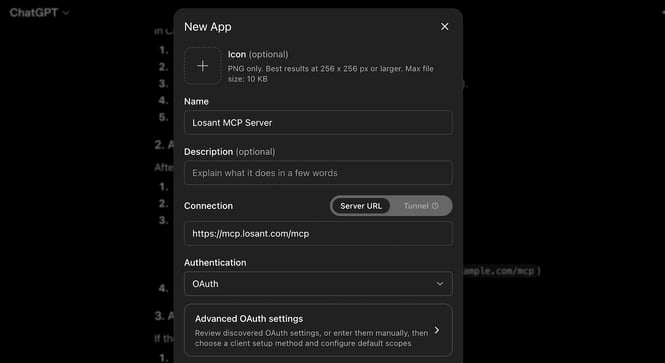
Using the MCP Server
The hosted version of Losant's MCP server is available at https://mcp.losant.com/mcp. Adding that as a connected service in your LLM of choice will redirect you to our new OAuth 2.0 flow, where you can authorize the LLM to access your account sandbox, member organizations, and even specific applications, as well as the level of access the tool is allowed against those resources. These settings are editable at any time within the OAuth Tokens settings in your Losant account.
You can also run the server as a Docker container on your local machine and provide it with a scoped token, which users who want to combine Losant data with other offline sources will find especially useful.
Unlocking the Power of AI
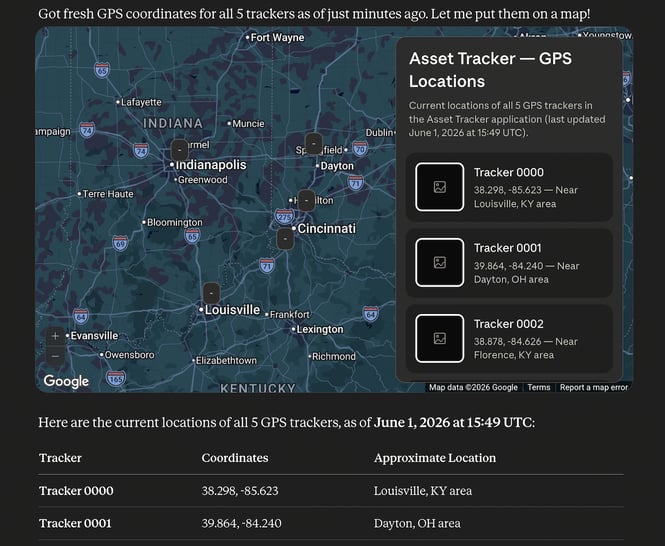
Once connected, you can prompt your AI agent to answer all kinds of questions about your Losant applications, such as:
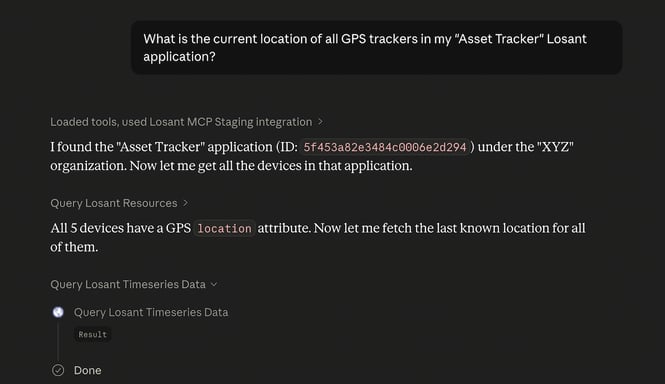
- Which of my workflows is invoking the "queryDynamo" AWS Lambda function?
- Which experience endpoints still need to be edited to use my version's default unauthorized reply?
- Are there any workflows still using inline authorization config that I can migrate to service credentials?
More to Come
For this initial release, the MCP server is scoped to read-only operations (analyzing device telemetry data, querying application resources) but we intend to quickly follow up with opt-in write operations, allowing LLMs to create dashboards and custom visualizations; debug and optimize workflows; and generate experience endpoint APIs.
Losant's new MCP server is open-source and is available on GitHub. We welcome feature requests, bug reports and – of course – user contributions. We'd also love to hear from our users how they are utilizing this new service in the Losant Forums.
Other Updates
As always, this release comes with other features and improvements, including:
- The Certificate: Create Node that was part of our previous release has several new enhancements that allow for overriding properties defined in the Certificate Signing Request (CSR) and for adding extensions to the certificate.
- We've added the same per-organization permission scopes to user API tokens that we include as part of the MCP server OAuth process. This allows for much greater control over which applications a token is authorized to act upon within third-party services.
- User API tokens, application API tokens, and instance API tokens now include "bounded" scope options, which expose all endpoints except those that could be used to clone or elevate a token's permissions levels (for example, by creating additional tokens or upgrading an org member's role). These scopes are the default for new tokens moving forward.
- Thanks to a user suggestion, the Device Connection Log Block now supports defining the number of entries to return per device.
What’s Next?
With every new release, we listen to your feedback. By combining your suggestions with our roadmap, we can continue to improve the platform while maintaining its ease of use. Let us know what you think in the Losant Forums.